
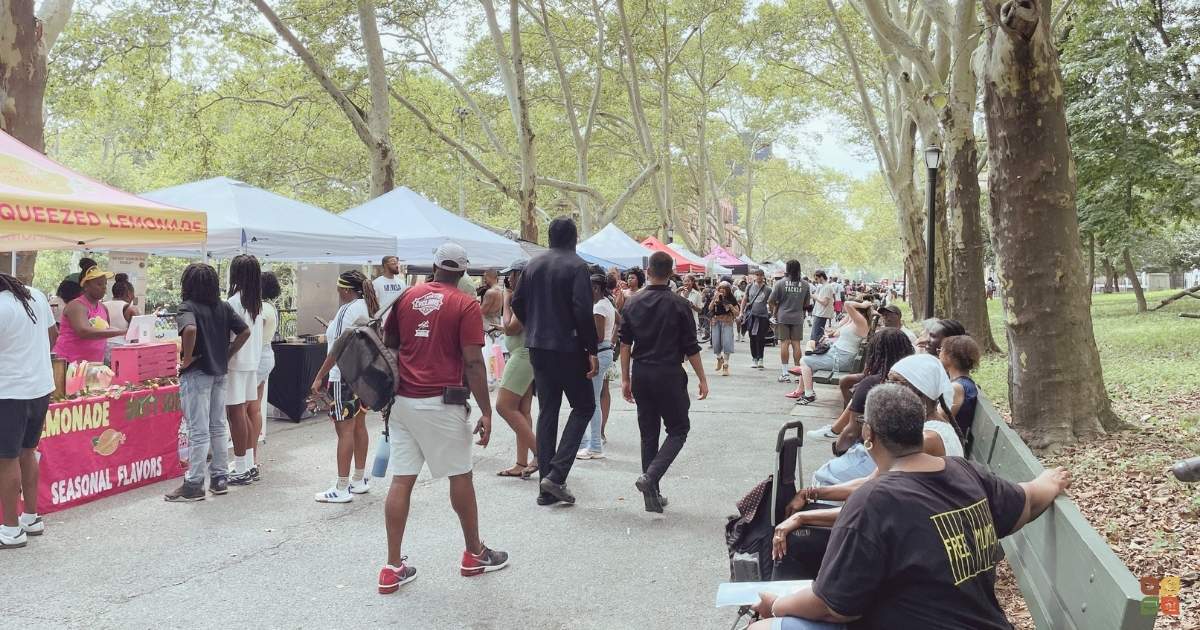
There is a difference between showing up in a community and showing up for one.
At Black VegFest in Brooklyn, we had the opportunity to do both.
The Humane Party didn’t arrive with a booth, a banner, or a carefully rehearsed pitch. This year, we came simply—as advocates, allies, and guests. We listened. We met people. We supported work already underway. We strengthened relationships that had been growing from a distance and started a few new ones.
And somewhere between the conversations, introductions, incredible food, and finally putting real-life faces to names we had known through screens, something became increasingly clear:
This is part of what building political power can look like.
Not swooping in. Not taking over. Not making every gathering an opportunity for recruitment.
Showing up. Building trust. Finding the places where our work intersects. And then figuring out what we can accomplish together.
Entering a Space That Wasn’t Built for Us
Black VegFest was created to center Black voices within veganism, animal advocacy, food justice, health, culture, and community.
We came knowing that we were entering a space created by and for a community that has too often had to fight to be heard—even inside movements supposedly committed to justice.
As white allies, our job wasn’t complicated.
We didn’t need to walk in and prove how supportive we were. We needed to support.
That meant experiencing the festival as it was intended, talking with people, learning about their work, celebrating what they had built, and looking for opportunities to stand alongside them without trying to squeeze the Humane Party into the center of the picture.
There is plenty of room in movement-building for leadership.
There is also tremendous power in knowing when to follow someone else’s lead.
Black VegFest gave us the privilege of doing exactly that.
From Screens to Side by Side
One of the best parts of the day was finally meeting people in person who had already become part of our expanding advocacy circle.
For months, so much of this work has happened through Zoom calls, emails, shared articles, campaigns, messages, introductions, and the wonderfully chaotic collection of tabs that comes with trying to connect people across movements.
Then suddenly, there we were together in New York.
No agenda.
No formal meeting.
No little Zoom boxes.
Just people walking through a festival, talking about advocacy, meeting others, exchanging ideas, eating some seriously good food, and seeing what happened.
Those casual interactions accomplished something that another scheduled meeting probably couldn’t have.
They made the network real.
We also met members of the Black VegFest organizing community and advocates whose work naturally intersects with ours. We weren’t walking around with membership forms. We were exchanging information, learning what people were working on, sharing what we were building, and leaving doors open.
Some of those conversations may grow into collaborations.
Some may simply become people who know they can reach out.
Both are worthwhile.
Building Something Bigger Than One Organization
The Humane Party has been thinking a great deal lately about what collaboration should look like as we continue evolving.
Political parties have traditionally been very good at asking people to join them.
We are increasingly interested in another question:
What can we build together without everyone having to join anything?
There are advocates, organizations, artists, writers, attorneys, educators, businesses, organizers, and community leaders already doing extraordinary work. They don’t need to become Humane Party staff members for us to support them. They don’t need to change their identity, abandon their organizations, or squeeze themselves into our structure before we can recognize shared goals.
Sometimes collaboration might mean supporting another organization’s campaign.
Sometimes it means offering our platform.
Sometimes it means making an introduction between two people who should have known each other years ago.
Sometimes it means signing a letter, circulating a petition, showing up at a hearing, sharing somebody’s work, or asking what resources we have that might help.
And sometimes it means getting ourselves to New York and walking around Black VegFest together.
So…What About Next Year?
This year was intentionally casual.
Next year?
We would love to come back.
And yes, perhaps with a table.
But I’ve been thinking a lot about what that table could actually look like.
I don’t want the Humane Party to arrive at Black VegFest next year, unfold a tablecloth, stack up some brochures and spend the day asking people to join our political party.
We can do better—and frankly, something more interesting.
What if part of that table belonged to the people we’re working alongside?
Imagine Humane Party information sharing space with campaigns from allied organizations. QR codes leading to petitions and community projects. Opportunities for Black advocates, writers, artists and organizers to bring their voices into The Humane Herald. Information connecting people with organizations doing work they care about. Maybe a rotating spotlight on campaigns that need signatures, volunteers, calls, donations, or simply more eyes on them.
Our political infrastructure can help carry other people’s work, too.
And if someone walks up wanting to learn about the Humane Party? Fantastic. We’ll be there.
But I would love for someone to also walk away having discovered an organization, campaign, writer, advocate, or opportunity they didn’t know about ten minutes earlier.
That’s a political presence worth building.
Being the White Folks at the Table
There is another part of this conversation that shouldn’t be danced around.
If we return with a formal presence next year, some of us standing behind that table will be white people at a festival intentionally created to center Black community and culture.
I don’t see that as a reason not to be there.
I see it as a reason to be thoughtful about how we’re there.
We aren’t going to Black VegFest to explain advocacy to Black advocates. We aren’t going there to put a Humane Party flag in the ground. And we certainly aren’t going there expecting anyone to be impressed simply because we showed up.
We’re going because these movements overlap.
Animal liberation overlaps with food justice. Environmental justice overlaps with political representation. Access to healthy food overlaps with economics. Advocacy overlaps with law. Culture overlaps with policy. And all of it overlaps with the larger question the Humane Party has been asking since its beginning:
What would our politics look like if compassion were actually built into the structure?
There are people throughout the Black community already answering pieces of that question through their own work.
We should know them.
We should listen to them.
And where invited, we should work alongside them.
Politics Can Look Like This, Too
One of the most exciting things happening inside the Humane Party right now isn’t a campaign for office.
It’s an evolution in how we’re thinking about what a political party can be between elections.
Politics doesn’t begin when someone files paperwork to become a candidate. It doesn’t disappear when the polls close.
It happens in community.
It happens through journalism, petitions, organizing, public testimony, education, art, coalition work, demonstrations, conversations, and people deciding that something happening around them isn’t acceptable anymore.
Sometimes political work looks like standing behind a podium.
Sometimes it looks like sitting around a board table.
And sometimes it looks like walking around Black VegFest, meeting people you have wanted to hug outside of a Zoom screen for months and discovering three more people you want to know before you make it back to the subway.
I want more of that for the Humane Party.
More relationships.
More unexpected connections.
More opportunities to help good work travel farther.
More rooms where we aren’t necessarily the biggest name on the banner—and don’t need to be.
Black VegFest gave us a glimpse of what that can look like.
This year, we came as guests and allies.
Hopefully, next year we’ll return with a table, a few more friends, stronger relationships, and an even better idea of how we can be useful.
Not because we need to make Black VegFest part of the Humane Party.
Because I believe the Humane Party can become a stronger political organization by being part of the communities already building the future we say we want.
And there is a lot of future worth building together.

