Educator, artist, union delegate, and longtime vegan advocate Monique Lukens has spent years bringing animal ethics into spaces where they are often absent—from classrooms and school districts to some of the largest educator gatherings in the country.
There is something Monique Lukens once said about her advocacy that has stuck with me: she sees herself as a pebble thrown into a pond.
The pebble does not control where every ripple travels. It cannot know who will notice it or how far the disturbance will reach. It simply has to be willing to hit the water.
For Lukens, that has meant repeatedly walking into institutions whose agendas encompass thousands of issues—education, labor, public policy, nutrition, curriculum, and workplace conditions among them—and asking them to make room for another question:
What about the animals?
Sometimes the answer has been no.
Sometimes an idea has gone no further than appearing in writing.
Sometimes she has stood before thousands of fellow educators knowing that many of them were not persuaded by what she was saying.
But every so often, something moves.
And for Lukens, getting the question into the room is itself part of the work.
A Life With More Than One Stage
Animal advocacy is only one piece of Lukens’ story.
She holds an MFA in Theatre from Sarah Lawrence College and a BA in Mathematics and Communications, with a Radio-TV-Film concentration, from Rowan University. She also completed a certificate in Electronic Music Production through SAE Los Angeles.
For decades, she worked part-time in radio at the South Jersey Shore under the name Unique Monique, becoming particularly associated with dance and electronic music. She has written original music, worked as an actor, and pursued comedy after relocating to Los Angeles.
That creative background matters when looking at the advocate she eventually became.
Lukens is comfortable with a microphone.
She is comfortable putting an unconventional thought before an audience.
And she is accustomed to making choices based on her values even when those choices cost her opportunities.
She recalls turning down artistic and commercial projects she felt conflicted with her ethics. Over time, those same convictions increasingly entered another part of her life: education.
The Moment Animals Looked Different
Lukens traces the beginning of her vegetarianism to 2001, while living in Washington Heights in New York City.
She remembers feeling particularly vulnerable during that period of her life and experiencing what she describes as a deeply spiritual awakening. Standing alone in her apartment one day, she looked at her wrist and was suddenly struck by the fragility of her own body.
Then she thought about the bodies of other animals.
“Wow, I’m a fragile creature eating other fragile creatures.”
The realization was immediate.
She stopped eating flesh.
Lukens describes the experience in explicitly spiritual terms and credits the Holy Spirit with helping her make that connection. The transition was not perfectly linear—she remembers slipping a few times early on and, with some humor, admits that giving up her preferred tuna sandwich was particularly difficult.
But the fundamental change remained.
She eventually became vegan and says she has now practiced ethical veganism for approximately two decades.
What began as a private moral realization would eventually become something much more public.
When Ethics Enter the Classroom
As an educator, Lukens began noticing how routinely the use of animals and animal products appeared in schools.
Sometimes it was obvious.
Other times, it was something as ordinary as a math lesson.
She remembers participating in a professional development exercise in which M&M’s were used to teach probability. Participants could eat the candy afterward.
Lukens did not want to handle the product because of ingredients she considered incompatible with her vegan ethics. She found a workaround so that she could participate, but the experience left her thinking about a much larger issue.
What happens when an educational exercise itself assumes that everyone in the room shares the same relationship with animals?
She sees the same question in word problems involving egg production, school meals, classroom experimentation, cleaning products, and field trips to zoos.
For Lukens, these are not disconnected complaints.
They all come back to one principle.
“I simply wish for what’s best for the sentient being.”
She wants educators, in particular, to consider the contradiction between teaching children kindness toward animals while simultaneously normalizing practices that treat animals as commodities.
“I really, really want educators to make the connection that animals are just like us in that they experience fear, have families, friends, faces, and feelings,” she said. “Anything we wouldn’t want done to us, likely they don’t want done to them either.”
A Conflict That Stayed With Her
Lukens’ advocacy within education did not begin with national conventions.
She remembers an experience dating to 2006, when she was teaching at a school where animals were kept.
After telling a security guard that she was vegetarian and saddened knowing the animals would be killed, Lukens says an administrator later approached her and questioned whether her beliefs created a conflict of interest with teaching there.
She remembers the experience as deeply upsetting.
Lukens did not return to the school for three years. She says support from people she encountered through the Annual Animal Rights Conference and Vegan Toastmasters helped her through the experience, and she later raised the question publicly at a school board meeting: Was simply being vegetarian on a school campus a conflict of interest?
She remembers some people chuckling.
The experience stayed with her.
So did other, smaller interactions—like the looks she remembers receiving when requesting vegetarian and later vegan options in school cafeterias.
For Lukens, those experiences became part of a larger realization: ethical veganism was not merely something she practiced privately. It could put her at odds with institutions whose ordinary practices assumed participation in animal use.
Years later, she would begin trying to change some of those practices from within.
Bringing Veganism Into Organized Education
Eventually, Lukens realized that her involvement in educator organizations gave her another avenue for raising these questions.
In 2023, she became an NEA delegate.
And she started submitting proposals.
Some addressed plant-based food access. Others touched animal experimentation, humane education, cruelty-free materials, agriculture, alternatives to zoo field trips, and recognition of animal-related observances.
By 2024, that work had reached the NEA’s formal legislative process.
Official NEA Representative Assembly materials identify Monique Lukens of California as the contact for Legislative Amendment 6, which proposed support for legislation implementing a national Farm to School program encouraging schools to serve “organic, whole plant-sourced foods” such as fruits and vegetables.
The accompanying impact statement cited nutrition, reduced exposure to harmful chemicals, and ecological sustainability.
Lukens says the amendment passed and credits vegan author and educator Dr. Will Tuttle as a co-writer. A Farm to School provision remains in the NEA’s current Legislative Program, although its final language is broader than the whole plant-sourced wording in Lukens’ original amendment.
But she wasn’t finished.
Taking the Question Before Thousands
One of Lukens’ most ambitious efforts came during the National Education Association’s 2025 Representative Assembly.
She proposed that the NEA establish a task force representing animal issues within the organization.
The potential scope was broad.
Lukens envisioned support for educators who object to animal experimentation, alternatives to teaching animal-based dietary guidance, and replacing educational trips to zoos with visits to sanctuaries.
The proposal did not hide its animal-rights framing. Lukens deliberately used language such as “carcasses” and “zoo jails.”
Why?
“I thought, why tip-toe around these facts?” she said.
She knew some readers would find the terminology eccentric or harsh. But seeing that language appear in an institutional document was, for her, part of the point.
“To see this in print was a bit bizarre, a bit funny, and highly satisfying, in a sad way,” she said.
Perhaps, she imagined, someone years from now might encounter one of those proposals and reconsider assumptions that once seemed ordinary.
The proposal also carried an unusual connection to the Humane Herald’s sister organization.
After Lukens reached out to the Humane Party while developing her animal-centered proposals, the idea of creating an animal-issues task force emerged through those conversations. Lukens developed and submitted the proposal, and the Party gave her permission to identify its support.
The official NEA record subsequently included the sentence:
“The Humane Party approves this proposal.”
Lukens then had to do something considerably harder than putting words on paper.
She had to stand before her fellow delegates and speak to it.
“This moment was difficult,” she remembers, “because I could tell from the audience they were not on board.”
The task force was not established at the Representative Assembly. Instead, NBI 40 was referred to the appropriate NEA committee.
But for Lukens, the proposal had already accomplished something important.
It existed in the official record.
It had been published in materials available to the thousands of delegates gathered for the Representative Assembly, and Lukens had spoken to the proposal before the body.
Animal issues had entered the institutional conversation.
For someone whose definition of success includes creating the first ripple, that truly mattered.
What Counts as Winning?
It would be easy to measure advocacy only by votes.
Lukens doesn’t.
“Can introducing an idea and getting people talking about it sometimes be a victory even when the vote doesn’t go your way?” I asked her.
Her answer was simple:
Yes.
Sometimes her objective has been to ensure an idea exists in writing and reaches a large audience, regardless of whether it wins majority support that year.
That philosophy helps explain her persistence.
Her language is sometimes intentionally uncomfortable. She wants the institutional record to contain ideas and terminology that might make someone stop—even years later—and reconsider a practice society once regarded as normal.
That is the pebble again.
Put the words somewhere they weren’t before.
See what happens.
When a Ripple Becomes a Win
But Lukens has also seen tangible movement.
Her work has extended beyond the NEA into the California Teachers Association, where she pursued recognition of National Animal Rights Day.
Lukens says that effort succeeded.
The recognition meant more than another date appearing on a calendar.
“This meant a lot,” she said. “It finally affirmed that animals meant something too to the educators.”
The win was particularly meaningful because she knows firsthand that animal-centered proposals can encounter resistance.
Her proposals over the years have touched everything from plant-based school food and animal experimentation to ethical veganism, cruelty-free educational materials, animal agriculture, and alternatives to zoo field trips.
Taken individually, they concern different policies.
Together, they represent something more interesting: an attempt to create space for animal ethics inside institutions whose primary mission is not animal advocacy.
That distinction matters, because animal movements naturally gather in spaces created by and for animal advocates.
But institutions are also changed by people who carry those ideas into classrooms, unions, professional associations, workplaces, local governments, and other places where the conversation may be harder.
Lukens has chosen those rooms.
Bringing the Work Home to Los Angeles
Her institutional advocacy hasn’t been limited to national and state educator organizations.
Since March 2026, Lukens says she has been communicating internally within her school district about greater recognition of ethical veganism and the ways animals and animal products appear throughout education.
In correspondence shared with the Humane Herald, she asked how ethical veganism could become more visible within district diversity efforts.
A response from the district’s diversity department invited her to submit vegan-related commemorations for consideration in future policy updates.
Lukens responded by proposing recognition of the World Day for the End of Speciesism.
It wasn’t a sweeping policy declaration.
It was an opening.
For Monique, openings matter.
She has also raised questions about everything from ingredients in educational materials to classroom exercises that normalize animal agriculture.
She points to math problems involving hens and egg production as an example. To most people, such a problem may appear entirely neutral—a simple exercise in multiplication.
Lukens sees another layer.
What assumptions about animals are being quietly passed along while the mathematics is being taught?
Whether everyone agrees with her interpretation isn’t really the point.
She wants educators to notice the assumption in the first place.
Education as a Place for Humane Change
There is particular significance to doing this work within education.
Schools don’t merely transmit facts. They help young people understand relationships, responsibility, community, and the world they inherit.
For Lukens, humane education belongs somewhere within that responsibility.
Her proposals have raised questions about what students are taught about animals used for food and experimentation, where schools take children to learn about wildlife, what materials educators purchase, and whether major education organizations should formally recognize movements advocating for animals.
Not everyone will arrive at the same answers.
But Lukens continues asking the questions.
And when I asked what she most wanted fellow educators to understand about animals, her answer stripped away all the organizational language, amendments, committees, and parliamentary procedure.
She wants them to see the individual.
“I really, really want educators to make the connection that animals are just like us,” she said.
For Lukens, animals experience fear and relationships. They have individual lives and interests. Her ethical conclusion follows from that understanding: if we would recoil from something being done to us, we should at least question why we accept doing it to another sentient being.
“See their bodies as spirit filled beings,” she said, “and let them live in peace.”
Veganism as an Ethical Identity
For Lukens, veganism isn’t simply a menu preference.
That distinction is central to her current advocacy.
She has pushed her school district to consider ethical veganism in conversations about diversity and accommodation, arguing that people whose veganism stems from deeply held ethical or spiritual convictions can encounter institutional practices that conflict with those beliefs.
Her own veganism is inseparable from her spirituality.
Lukens speaks openly about her Christian faith and her reverence for figures including Saint Francis of Paola, whom she regards as an example of spiritually grounded compassion toward animals.
Her language about animals frequently reflects that spiritual framework.
She doesn’t see an animal simply as an organism whose welfare should be improved.
She sees a life.
A being.
Something sacred enough to be left in peace.
Different Organization. Different Audience. Same Pebble.
Lukens’ work does not fit neatly within a single organization.
She has participated in educator unions, animal advocacy, public discussions, creative work, and other organizing spaces. She also hosts a monthly online conversation, First Sunday of the Month with Monique, where she brings people together for discussion.
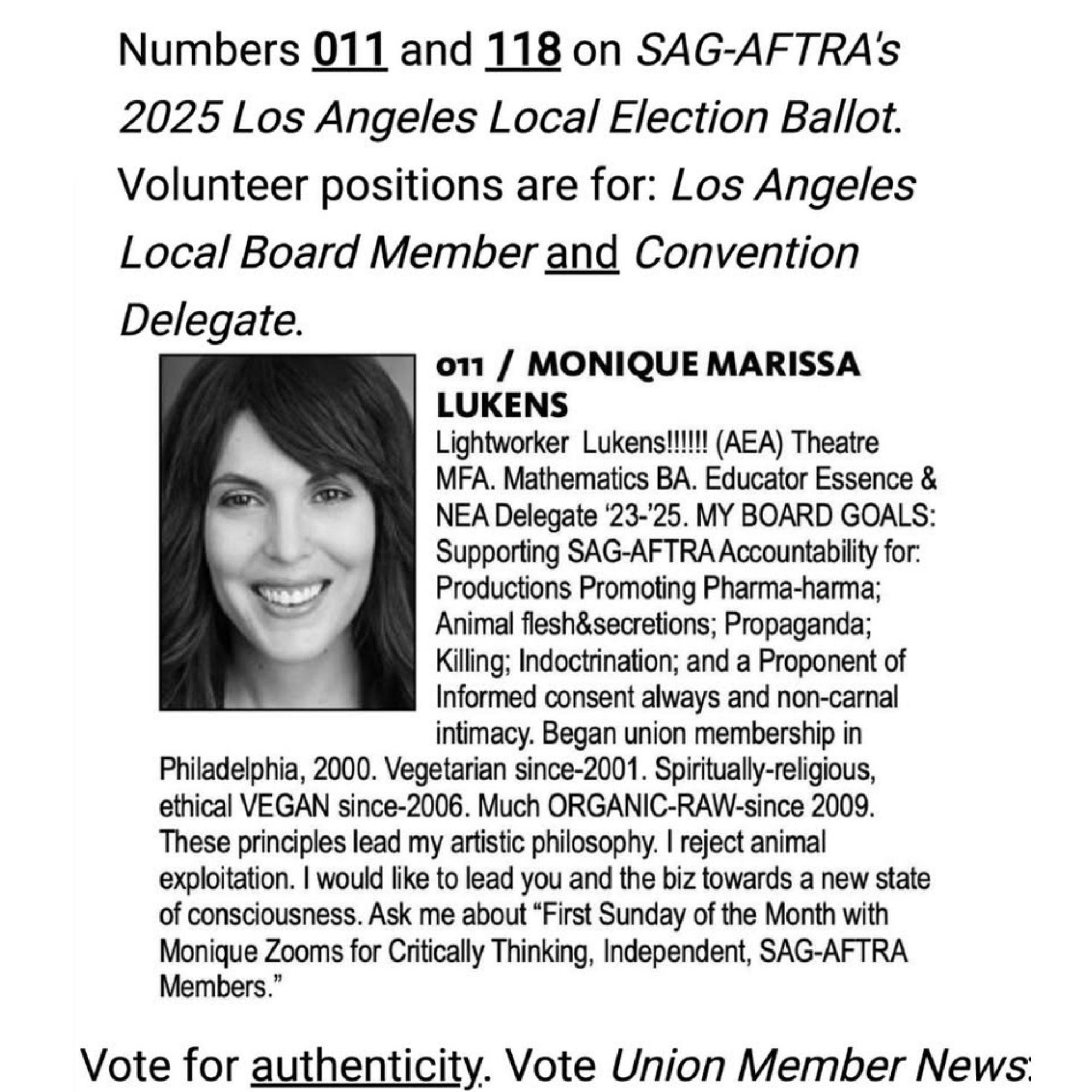
In 2025, she appeared on the ballot for volunteer leadership positions within SAG-AFTRA’s Los Angeles Local, running for both Local Board Member and Convention Delegate.
And there, too, were the animals.
Her candidate statement identified opposition to animal exploitation as part of the principles informing her artistic philosophy and called for greater accountability around productions involving animal flesh and secretions, among other issues.
Different organization.
Different audience.
Same pebble.
The through line isn’t a particular institution.
It’s Lukens’ belief that wherever she has a voice, she can use it to raise a question that might otherwise go unasked.
How to Be the First Person to Ask
There is another reason Lukens’ story matters beyond the particular policies she has proposed.
Most people who recognize something they dislike inside an institution are not standing before thousands of delegates.
They’re sitting in a staff meeting.
They’re looking at something their workplace has always done.
They’re wondering whether they’ll sound ridiculous if they’re the first person to question it.
So I asked Lukens what she would tell another educator, union member, employee, or advocate who sees something within their own institution that they believe should change.
Her suggestion was surprisingly gentle.
Ask a question.
Rather than beginning with an accusation, she suggested posing an idea in a way that invites someone else to consider the inconsistency.
Her example:
“Hey. I know we tell our students to be kind to animals. Do you think we could also begin purchasing cruelty-free school supplies to align with what we teach the children?”
That approach says something important about the way Lukens sees institutional change.
The pebble doesn’t have to be a boulder.
Sometimes it is simply the first question.
“What Is in the Best Interest of All?”
Toward the end of our exchange, Lukens wrote something that may explain her sprawling collection of interests better than any résumé could.
“When I click on the keyboard, turn on the camera, speak to voting members, a classroom, an audience,” she said, “I am always thinking about how I may serve, and what is in the best interest for all.”
What makes Lukens’ story worth telling isn’t that she has won every argument.
She hasn’t.
It isn’t that every proposal passed.
They didn’t.
It is that she keeps identifying places where animals have been left outside the conversation—and then tries to put them back into it.
That can mean procedural rules, signatures, committees, debate, votes, revisions, setbacks, and another attempt.
It can mean being the person standing at the microphone while realizing that much of the room isn’t with you.
And then coming back.
The Pebble
I returned to that image before we finished.
What keeps someone willing to be the pebble when making ripples can mean being the person in the room saying something no one else is saying?
For Lukens, the answer came back to animals themselves.
“It’s not right to induce pain on innocent beings,” she said. “They are a part of nature.”
She believes that having a platform creates an obligation to use it.
Maybe the next attempt changes one policy.
Maybe one person reconsiders something.
Maybe the idea travels somewhere she never expected.
“Maybe this next dunk will be the one which makes a small change,” she said. “Maybe it will go across an ocean.”
That may be the most fitting way to understand Monique Lukens’ activism.
Not every pebble changes the shape of the pond.
But there can be no ripple without first disturbing the surface.