

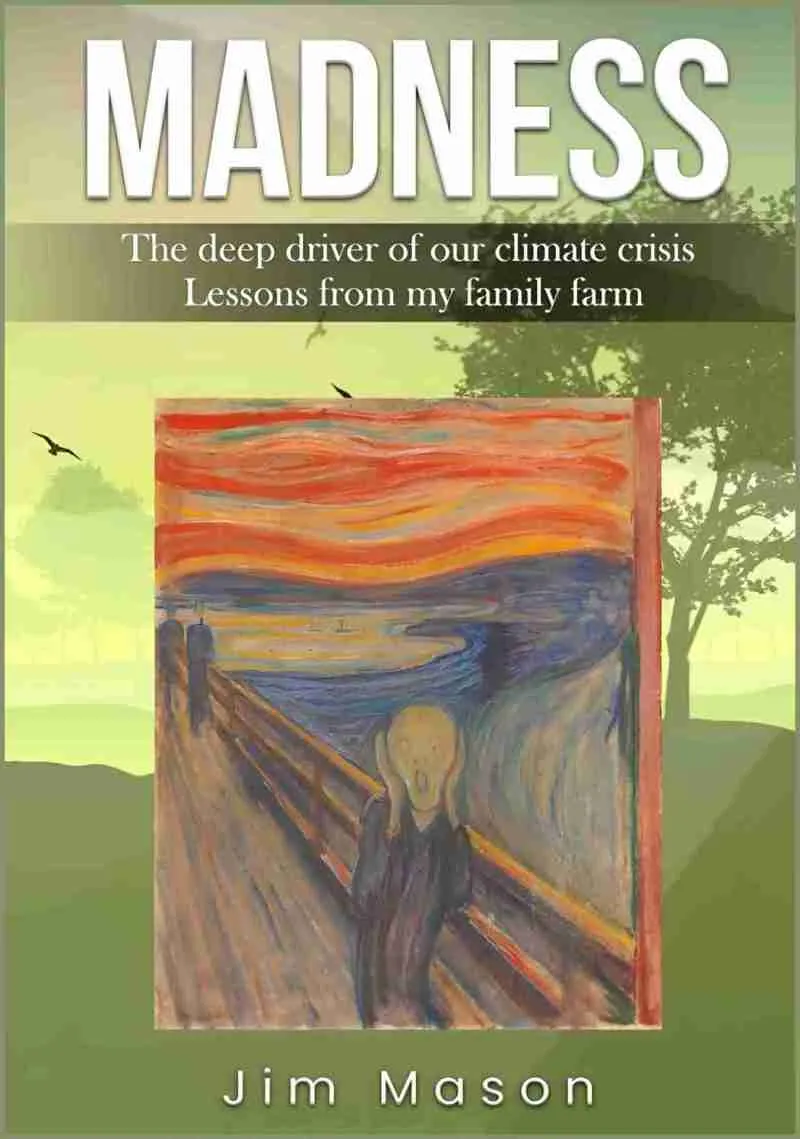
Reading Madness feels less like absorbing an argument—and more like having the ground
pulled out from under you.

There’s something almost jarring about reading Jim Mason when you’re not expecting him. Not because he’s obscure—but because he refuses to behave the way most writers do. He doesn’t ease you in. He doesn’t soften the language. He doesn’t build toward a polite conclusion that lets you close the book feeling informed but unchanged.
He just… says it.
And in Madness, what he’s saying is not small.
This isn’t a book about animal rights in the narrow sense. It’s not even really a book about ethics as we usually frame it. It’s a book about what we’ve built as a species—and the uncomfortable possibility that something about it is fundamentally wrong.
Not flawed. Not in need of reform.
Wrong.
Not Broken—But Distorted
One of the things that hits hardest while reading Madness is the shift in perspective.
Most of us—even those of us deep in advocacy—tend to think in terms of fixing things. Reforming systems. Improving outcomes. Making a bad world better.
Mason doesn’t quite play that game.
Instead, he seems to be asking a more unsettling question: What if the system itself isn’t just malfunctioning—but functioning exactly as it was built to?
A world rooted in domination. In hierarchy. In control.
A world where violence isn’t an anomaly—it’s infrastructure.
And once you see it that way, it’s hard to unsee.
The Throughline: Domination
If you’re familiar with Mason’s earlier work, especially An Unnatural Order, this won’t feel entirely new—but it does feel sharper here. Less theoretical. More… stripped down.
There’s a throughline running quietly but persistently beneath the surface: domination isn’t something we occasionally fall into.
It’s something we’ve normalized.
The way we treat animals isn’t separate from how we treat each other. It’s not a niche issue or a single moral failing. It’s part of a larger worldview—one that sorts beings into categories of use, value, and expendability.
And once that framework is in place, it doesn’t stay contained.
It expands.
Why the Tone Matters
Let’s talk about the tone for a second—because it’s going to turn some people off.
Jim Mason writes the way some people speak when they’ve stopped trying to be tolerated.
He is blunt. Sometimes abrasive. There’s no attempt to package these ideas in a way that feels safe or easily digestible. And honestly, that’s part of what makes the book work.
There’s a kind of moral clarity that gets lost when everything is filtered, softened, and made “accessible.” When language becomes more about not offending than about telling the truth.
Maddening might be a better word than Madness for how this book can feel at times—but maybe that’s the point.
If the subject is a world built on normalized harm, why would the tone be gentle?
Reading This as a Vegan
There’s a specific kind of recognition that happens reading this as someone already engaged in animal advocacy.
Not because Mason is telling you something you’ve never heard—but because he’s saying it without compromise.
No strategic softening. No “meeting people where they are.” No careful calibration of language to avoid pushing too far.
Just a clear, unwavering throughline: this system is built on domination, and domination doesn’t become ethical just because it’s normalized.
And there’s something… grounding in that.
Not comfortable. But grounding.
Anger, Grief, and Something Underneath It
It would be easy to read Madness as purely angry.
And there is anger here. A lot of it.
But if you sit with it long enough, something else starts to come through.
Grief.
Grief for animals. For ecosystems. For the version of humanity that never quite materialized—or maybe was lost somewhere along the way.
And maybe that’s what gives the book its weight. It’s not anger for the sake of provocation. It’s anger rooted in recognition. In seeing something clearly and not looking away.
Why This Book Sticks
Madness doesn’t resolve itself neatly.
It doesn’t offer a roadmap. It doesn’t hand you a list of next steps or a reassuring sense that change is just around the corner.
What it does instead is strip things down.
It asks you to look at the world—not as we’re told it is, but as it functions. To question the assumptions that feel so embedded we rarely even name them.
And once you start doing that, it’s hard to go back.
Final Reflection
Madness isn’t necessarily a comfortable read—and I don’t think it’s meant to be.
But I do think it’s a book that stays with you.
Because every once in a while, you come across a voice that isn’t trying to persuade you gently or win you over incrementally. It’s not trying to be palatable. It’s not trying to meet the moment halfway.
It’s just trying to tell the truth as plainly as possible.
And reading it, I found myself sitting with a quiet, uncomfortable recognition—not just of the systems Mason is critiquing, but of how deeply embedded they are. How easy it is, even for those of us who see parts of it clearly, to still be living inside of it.
Maybe that’s the real weight of Madness.

Editor’s Note
I absolutely recommend reading Madness. 100% recommend.
Not because it’s easy, uplifting, or designed to reassure the reader—but because it challenges you to think more deeply about the world we’ve inherited and the systems we participate in, often without realizing it.
There’s something refreshing about a writer who refuses to dilute his convictions for the sake of comfort. Whether readers ultimately agree with every conclusion or not, Mason’s work leaves an impression—and more importantly, it leaves questions behind.
And those questions matter.

