
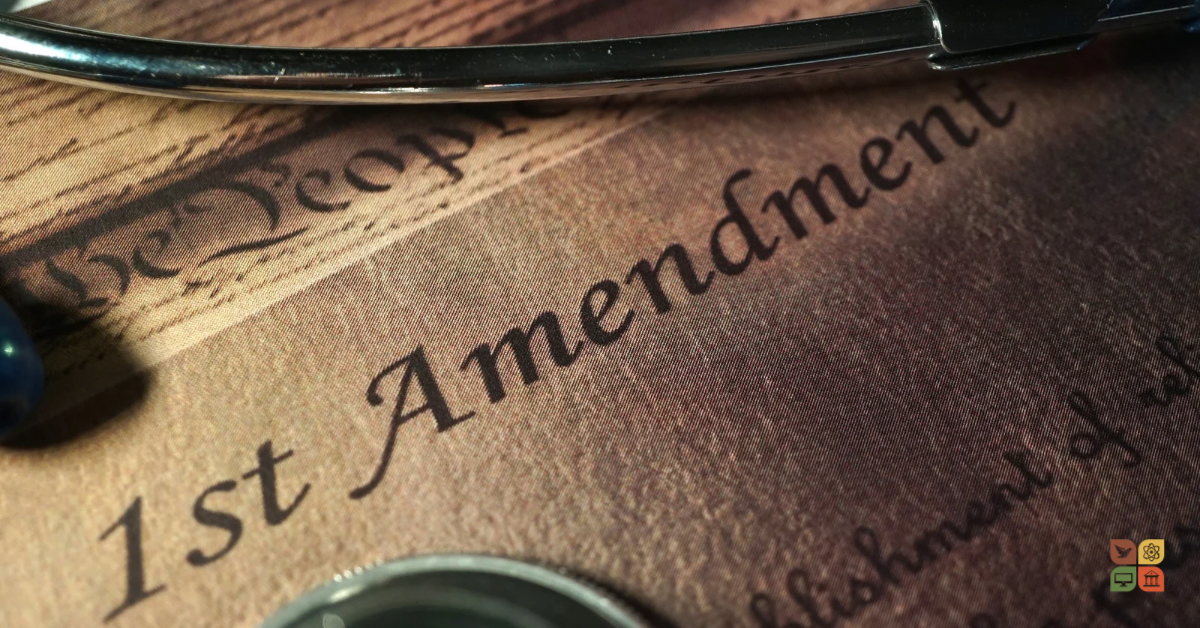
The First Amendment is more than words on parchment. It is the living guardrail of democracy, designed to protect dissent, critique, and satire from the powerful. Yet in 2025, that guardrail is buckling under pressure. The past year has seen a troubling pattern: entertainers pulled from the air, journalists locked out of press briefings, and outspoken commentators sidelined when their words clash with political or corporate interests.
Kimmel’s Suspension and Affiliate Power
The suspension of Jimmy Kimmel Live! earlier this month may have looked like late-night drama, but its implications run far deeper. Disney and ABC pulled the program following a controversial monologue, and although it was later reinstated, major affiliate groups initially refused to air the show.
This blackout underscored a dangerous reality: even when a network decides to restore a program, powerful affiliates can act as gatekeepers, deciding which voices audiences in entire regions are permitted to hear. Free speech protections ring hollow if satire can vanish from airwaves at the discretion of a handful of corporations.
Colbert’s Exit
Kimmel’s ordeal is not isolated. The announced end of The Late Show with Stephen Colbert earlier this year raised similar alarms. Though officially framed as a business decision, many viewers saw the move as part of a broader recalibration of late-night television — one that coincidentally sidelines some of the sharpest critics of those in power.
Satire has always been a democratic watchdog. When its leading voices are removed, voluntarily or otherwise, the culture of dissent is weakened.
Journalists and the White House
The threats are not limited to entertainers. The White House this year has restricted access to select press outlets, choosing which journalists may ask questions and which are barred. This undermines the foundational principle that government must be accountable to all of the press, not just the outlets it favors.
Independent journalism, particularly from reporters willing to challenge official narratives, cannot function in a climate where credentials can be revoked for asking the “wrong” questions.
Maddow and the Silencing of Commentary
Cable news has also seen upheaval. Voices like Rachel Maddow’s have faced growing pressure as networks restructure their political coverage. While couched in terms of programming strategy, these shifts disproportionately marginalize outspoken critics of government policy. When prominent commentators are steadily edged off the air, it signals to others in the industry that strong dissent carries career risk.
The Chilling Effect Across Media
Taken together, these episodes reveal a troubling architecture of modern censorship. It does not always arrive as a government order stamped with official seals. More often, it creeps in through subtler means:
•Regulatory signals that hint at consequences for noncompliance.
•Corporate risk calculations that prioritize advertiser comfort over principle.
•Affiliate refusals that fracture access and silence dissent in entire regions.
•Selective press access that rewards loyalty and punishes critique.
•Career penalties — cancellations, contract nonrenewals, sidelining — that make speaking out a professional gamble.
The result is the same: fewer voices willing to speak truth to power.
Historical Echoes, Present Risks
American history reminds us that press freedom has always required vigilance. Nixon’s enemies list, prior attempts to bar outlets from coverage, and repeated efforts to weaponize federal agencies against the press are all reminders that democracy falters when criticism is suppressed.
The Supreme Court has reaffirmed again and again that prior restraints on speech are unconstitutional. But today’s restraints often wear different clothing: economic threats, corporate discretion, or affiliate veto power. The method is modern, but the effect is timeless — a narrowing of the public square.
What Must Hold
For free speech to endure, three institutions must hold firm:
•The Government, by refraining from coercion and favoritism.
•Corporations, by resisting pressure and upholding principle over profit.
•The press and creators, by refusing to self-censor in the face of risk.
When any of these falters, speech becomes symbolic rather than substantive.
The Stakes
As late-night hosts are muzzled, as journalists are excluded from briefings, and as political commentary grows ever thinner, the question becomes unavoidable: is the First Amendment still a guarantee of dissent, or merely a promise subject to corporate and political convenience?
The answer will define not only the future of satire and journalism, but the health of American democracy itself.
 The Humane Herald