Humane National Committee (HNC) Structure
The Humane National Committee (HNC) is the future governing body of the Humane Party. Its structure includes a total of 144 seats, grouped into three classes of 48 seats each, as follows:
- Class A: elected for terms of 2 years
- Class B: elected for terms of 4 years
- Class C: elected for terms of 6 years
Note that, while these classes represent different constituencies and serve different lengths of term, the HNC is not tricameral. Rather, the HNC makes decisions as a single body, not as separate houses. This approach contrasts to the bicameral approach of the U.S. Congress, for instance, in which the Senate and House of Representatives act as separate bodies.
Note also that all members of the HNC, regardless of which constituency they serve, must execute the Humane Party Oath, thus ensuring that they are vegan personally and abolitionist politically.
Classes
The three classes of seats serve constituents categorized according to different criteria as follows:
Class A (geography-based distinctions)
- 40 members representing a grouping established according to Congressional districts (default of about 11 Congressional districts per member)
- 8 members representing a grouping established according to recognized U.S. eco-regions
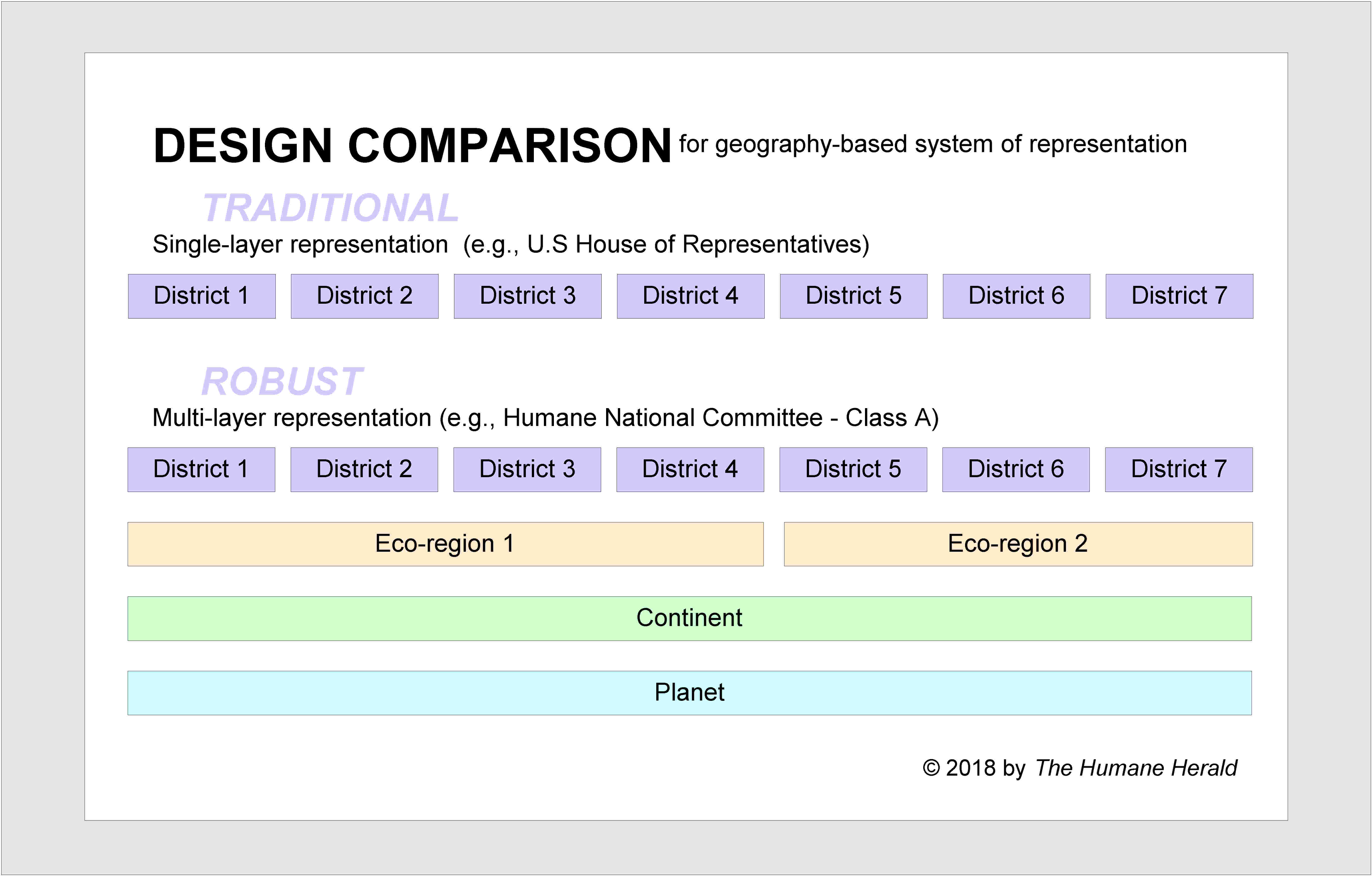
Class A of the HNC embodies a significant advance over the traditional model of geography-based representation. Under traditional models, exemplified by the U.S. House of Representatives, each voter has exactly one representative in the given decision-making body.
For instance, as shown, a voter in district 3 of a given state will be represented by the House member who represents district 3, but the voter will have no other representatives in the House. Such a model gives rise to certain risks. For instance, if the voter’s representative does not have a clear vision with respect to a given issue, the voter has no other representative (in the House) to turn to for help.
By contrast, in Class A of the HNC almost every voter has four layers of representation: district, ecoregion, continent, and planet. This overlapping, multi-layer approach gives voters more options regarding whom to contact when facing a given issue that they feel should be addressed by the HNC. This approach also allows a given issue to be viewed from several different levels of specificity or generality, making it less likely that certain types of issues or insights will be overlooked.
Another advantage is that inclusion of three layers defined by naturally occurring phenomena—ecoregion, continent, and planet—enables more effective focus on issues and natural convergence on solutions than human-made divisions allow. Anthropocentric boundaries are often almost completely artificial; many states’ boundaries, for example, feature lines that have no relationship whatsoever to the actual geographic or ecosystemic features of the given area. Such artificiality impedes rather than promotes effective making and implementation of policy by introducing unnecessary and irrational boundaries between naturally aligned political interests.
Class B (political vulnerability, political process, and rule of law)
- 40 members assigned to represent politically vulnerable human minorities
- 8 members assigned to represent the entire population with respect to safeguarding the political process itself, the rule of law, and related concerns
Specifics seats include:
- seats defined according to biological age
- seats representing interests arising in relation to biological sex; gender; sexual orientation; marital or relationship status; familial relations; parenthood, procreation, and adoption; child-free; singlehood
- seats representing interests arising in relation to race; ethnicity; religion; language; physical appearance
- seats representing interests arising in relation to national origin; immigration; migration; citizenship; refugee status
- seats representing interests arising in relation to special needs, including hearing, visual, and mobility impairment, and mental health
- seats representing interests arising in relation to work or life stage; employment; occupation; student; retirement; veteran status
- seats representing interests arising in socioeconomic status or life setting not otherwise captured above
- seats addressing societal concerns that impact everyone under U.S. jurisdiction (e.g., freedom of speech; access to education and information)
Through this structure, Class B protects politically vulnerable groups whose interests may go unrepresented in a purely geographical design, as in the U.S. House of Representatives, since a given group may not comprise a majority in any jurisdiction yet still need representation.
For instance, imagine a hypothetical country where a first group constitutes 70% of the population and a second group constitutes 30%. If this relationship holds equally across the given country’s different voting regions and each region elects its representative by simple majority vote, then the first group may win 100% of the seats while the second group goes unrepresented.
By contrast, Class B of the HNC ensures representation for groups whose interests may otherwise go unrepresented. This approach improves the HNC’s ability to maintain internal and public policy that serves the interests of the whole population, not just that of the most powerful group.
Meanwhile, the pressing importance of including eight seats that represent the entire population in its need to safeguard the political process and the rule of law has been highlighted by events in recent years.
Note that the representative for a given group need not be a member of that group. For instance, representatives for the interests of children will, of course, be adults.
Class C (constituencies instantiated without humans)
- 40 members assigned to represent sentient beings by taxonomy, physiology (e.g., insects, birds, mammals, fish)
- 8 members assigned to all beings with respect to particular environmental concerns (e.g., water quality, climate, deforestation)
While all three classes enjoy significant advantages over traditional models for representation, Class C is specifically tailored to providing representation to animals of other species—not the human kind. This zoocracy model of government provides a political structure in which animals of other species are the literal constituents who are represented by the given representative, in a manner analogous to that in which a legal guardian represents a child in legal matters. The individual seat structure for Class C has not yet been published in final form and is likely to undergo significant revisions over time, since scientific advances will continually improve our understanding of other species. The pace of such improvement is likely to quicken with the benefit of AI.
A sample of specific seats slated to populate this class includes:
organisms that satisfy the definition of:
- pollinators
- other terrestrial arthropods
- arthropoda not represented above
- terrestrial herbivorous (primary consumer) mammals
- other land mammals
- mammalia not represented above
- terrestrial birds
- aves not represented above
- bony fish
- sharks and other aquatic chordates
- chordates (e.g., reptiles, amphibians) not represented above
- plausibly sentient eukaryotes not represented above
all sentient beings to the degree that they are impacted by the health or healthfulness of:
- plantae
- fungi
- eukaryotes not represented above
- prokaryotes
- large changes in topography (e.g., dams, mining); other anthropogenic land development (e.g., paving, building, clear-cutting), disruption, and interference
- soil, water, air, and atmosphere quality; changes in temperature and climate
- anthropogenic energy capture, transmission, and use; anthropogenic noise, vibration, light, odor, and appearance; anthropogenic consumption, waste, litter, pollution, and contamination; human travel and transportation; anthropogenic introduction of exotic and invasive species, hybridization, breeding, genetic manipulation
- combined or additional anthropogenic impact on environment; anthropogenic ecosystems (e.g., cities)
Through Class C, the HNC embraces the fourth stage of political development: government not for the one, the few, or the many, but for all. Class C thereby recognizes not just animal personhood but animal peoplehood: other animals’ status of having political standing. This approach enables all beings within jurisdiction of the United States to have their interests represented in determining HNC policy, the vast majority of whom have previously gone fully unrepresented in U.S. political, social, and economic matters. By enfranchising heretofore unenfranchised populations, the HNC more fully adheres to the touchstone of governmental legitimacy—consent of the governed—than any prior model for governance.
Note that Class C also provides seats which fully address the extremely important concerns of effectively stewarding non-sentient matter (e.g., water quality, soil quality per the above) and mechanisms (e.g., transportation, cities per the above) through representatives who represent the entire population of sentient beings with respect to these concerns. This approach preserves the value of legal personhood and political peoplehood and avoids the erosion of such value that would result if personhood and peoplehood were extended to inanimate objects.
Looking Ahead
The Humane National Committee will one day replace the current governing structure of the Humane Party, which is an interim entity tasked with incubating the political movement to the point where this transition can be put into effect. Activists who wish to help build the movement are invited to contact the Humane Party and indicate your interest.
~ Shelley Harrison
 The Humane Herald