
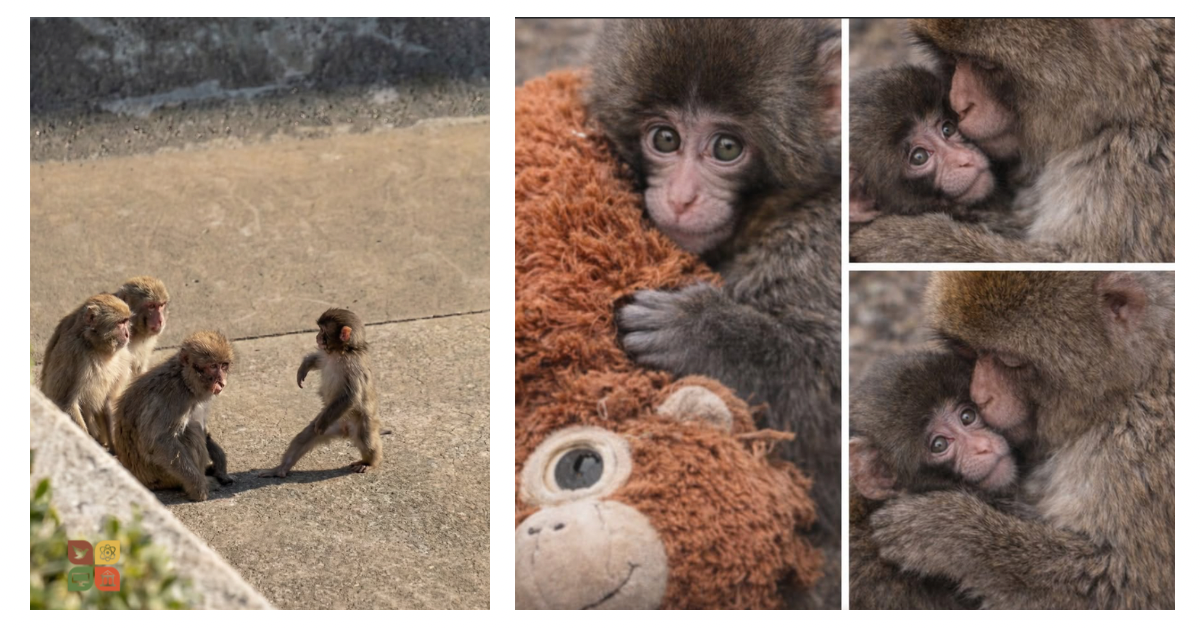
When a baby Japanese macaque named Punch went viral for clinging to a stuffed toy after being abandoned by his mother, the internet reacted the way it always does: with heartbreak, projection, and relief when the story turned hopeful.
Eventually, an adult female began grooming him. He integrated into the troop. He left the plush behind.
The narrative was simple: a lonely baby, bullied and rejected, finally finds love.
But primate societies are not moral fables. They are biological systems. And if we are going to tell Punch’s story, we owe it accuracy.
The Structure Behind the Struggle
Japanese macaques (Macaca fuscata) live in tightly structured, matrilineal troops governed by hierarchy. Rank is inherited through the mother. Social stability depends on clarity: who outranks whom, who grooms whom, who yields space, who receives protection.
Infants are not neutral members of the group. They are extensions of their mothers’ status.
When a mother abandons an infant — whether due to inexperience, illness, stress, or environmental disruption — the infant does not simply lose affection. He loses social standing. He loses protection. He loses political backing within the troop.
In a rank-based society, that is a profound vulnerability.
What humans label “bullying” is often dominance reinforcement. Lower-ranking individuals are displaced, tested, chased, or corrected. These behaviors look cruel through a human lens. In macaque society, they serve structural functions:
• Reinforcing hierarchy
• Maintaining predictable order
• Signaling coalition strength
• Teaching juveniles social boundaries
It is not sentimental. It is survival.
Captivity and Compression
In the wild, macaque troops are expansive. Individuals can create distance. Subordinates can avoid aggressors. Social tension dissipates across geography and time.
In captivity, space is finite. Escape is impossible. Coalition dynamics become compressed.
Research across multiple primate species shows that captive environments can:
• Increase rates of redirected aggression
• Intensify dominance policing
• Elevate chronic stress markers such as cortisol
• Reduce opportunities for avoidance and self-regulation
When social mammals cannot create distance, stress does not evaporate. It concentrates.
Maternal abandonment itself can also be influenced by captivity-related stressors, including enclosure design, troop composition, and constant human presence. While abandonment does occur in wild populations, altered environments change the variables that shape bonding, stress, and maternal behavior.
Punch’s vulnerability did not arise in a vacuum. It emerged within a constructed social and physical system that shaped the pressures around him.
The Stuffed Animal Was Not “Cute”
Punch’s attachment to a plush toy was framed online as heartbreakingly human. But the behavior is biologically consistent with primate stress regulation.
Decades of primate research demonstrate that tactile comfort plays a central role in emotional development. Contact — not food — regulates stress in infant monkeys. Grooming releases oxytocin. Physical closeness reduces cortisol.
When maternal contact is absent, infants may redirect attachment behaviors toward substitute objects. It is not symbolic. It is neurological.
The plush was not a sentimental prop. It was a coping mechanism.
What Actually Changed
When an adult female began grooming Punch, everything shifted.
In macaque society, grooming is not casual affection. It is social currency. It communicates alliance. It extends protection. It alters status perception within the troop.
With grooming came:
• Oxytocin release
• Reduced stress response
• Increased social legitimacy
• Buffering from aggression
Punch did not make a “heartwarming decision” to abandon the toy.
He no longer needed it.
Belonging replaced substitution.
The Deeper Lesson
Punch’s story resonates because humans are also hierarchical social mammals. We understand exclusion. We understand protection. We understand that belonging is not sentimental — it is physiological.
But viral narratives flatten complexity.
Macaques are not villains. They are not bullies. They are intensely social primates navigating rank, alliance, and survival.
When those dynamics unfold within confined systems, their pressures become more visible — and sometimes more acute.
Punch survived because a bond formed.
That is powerful.
But the larger lesson is not that monkeys learned kindness.
It is that social mammals unravel without protection — and that structure determines who thrives and who becomes vulnerable.
Belonging heals.
But systems decide who must struggle to find it.
Editor’s Note:
Stories of animals in captivity frequently go viral for their emotional appeal, while the structural realities shaping those animals’ lives remain unexamined. This editorial looks beyond the sentimental framing of Punch’s story to explore macaque social hierarchy, stress biology, and the impact of confinement on complex social mammals. The Humane Herald does not romanticize captivity; we interrogate it.
 The Humane Herald