
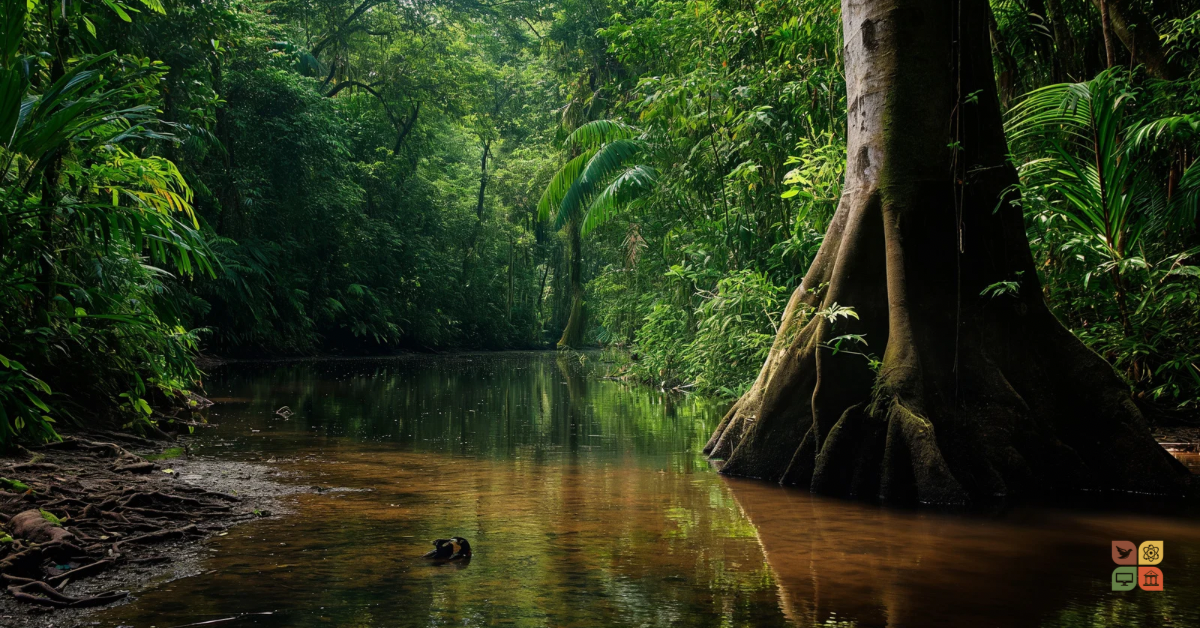
On December 5, we confront a truth the federal government refuses to speak: the world’s rainforests are dying, and with them, the future of every species—including our own.
Rainforests represent one of Earth’s oldest, most intricate, and most life-sustaining ecosystems. They generate much of the planet’s oxygen, stabilize the climate, store immense carbon reserves, and support over half of all terrestrial species—many found nowhere else on Earth. And every December 5, nations across the world acknowledge this fact through rain-forest protection observances that rarely make U.S. headlines.
But acknowledging the rainforest is not the same as protecting it.
Rainforest destruction is accelerating, driven overwhelmingly by industrial animal agriculture, mining, fossil fuel extraction, commercial logging, and land-grabs targeting Indigenous communities. These are not abstract environmental concerns; they are political decisions—ones our government continues to normalize, subsidize, and excuse.
The Amazon Is Closer to Collapse Than Ever
Scientists warn that the Amazon is nearing a “tipping point”: the moment when deforestation and warming transform the rainforest into a dry savannah, permanently altering global weather patterns.
Right now:
• 80–90% of Amazon deforestation is linked to cattle ranching and feed crops.
• The Congo Basin, Earth’s second-largest rainforest, faces intensifying pressure from logging, oil exploration, and illegal wildlife trafficking.
• Southeast Asian rainforests, home to orangutans, clouded leopards, and hornbills, are disappearing under palm-oil monocultures and extractive industries.
These forests are not dying naturally. They are being killed.
The Human Toll: Indigenous Nations on the Front Lines
Every rainforest is an Indigenous homeland. And every assault on those forests is an assault on the people who defend them.
Indigenous groups—many of whom have protected these ecosystems for thousands of years—are facing:
• Forced displacement
• Criminalization of land and water defenders
• Assassinations of activists
• Government-backed corporate expansion into ancestral lands
These are not isolated incidents. They are patterns of violence tied to global economic systems that value land more when it is stripped, mined, grazed, or burned than when it is alive.
The Animal Toll: Extinction as Policy
Rainforest loss is not a side effect of development; it is a direct cause of the modern extinction crisis.
When rainforests fall, entire species disappear with them.
From jaguars and sloths to frogs, insects, birds, and primates—every tree felled, every acre burned, every road carved through protected land accelerates a cascade of suffering and death. Factory farming, leather exports, and feed-crop expansion are among the most brutal drivers of biodiversity collapse, though rarely framed as such by mainstream journalism.
The Humane Party rejects the language that sanitizes these realities: terms like harvesting, resource extraction, and land management. These are euphemisms for killing, displacing, and erasing living beings—and for accelerating a global ecological breakdown we will not be able to reverse.
The Government Silence: A Choice, Not a Glitch
The United States remains one of the largest importers of rainforest-linked products—beef, leather, palm oil, animal feed, timber, and minerals.
This means the rainforest crisis is not merely “over there.” It is directly tied to U.S. trade decisions, corporate subsidies, and agricultural policies.
And at a time when federal agencies are going silent on climate, environmental oversight, and biodiversity protection, December 5 is a reminder that silence is not neutral. It is complicity.
What a Humane Policy Would Look Like
A future rooted in ethics—not extraction—would require:
• Ending U.S. imports linked to deforestation and animal-agriculture expansion
• Supporting Indigenous sovereignty as a climate and human-rights imperative
• Investing in plant-based food systems, not feed crops and cattle
• Rejecting “sustainable meat” narratives that hide rainforest destruction behind branding
• Using diplomatic, economic, and technological power to halt global deforestation rather than subsidize it
Protection is not merely conservation—it is abolition of the systems causing harm.
A Final Reflection
Rainforests are not infinite. They are not regenerating fast enough to survive current pressures. They are not guaranteed to exist for our children, or for the children of any species.
If today is an International Day for the Protection of the Rainforest Ecosystem, then let it be more than a symbolic reminder.
Let it be the day we choose the living world over the industries consuming it.
 The Humane Herald