
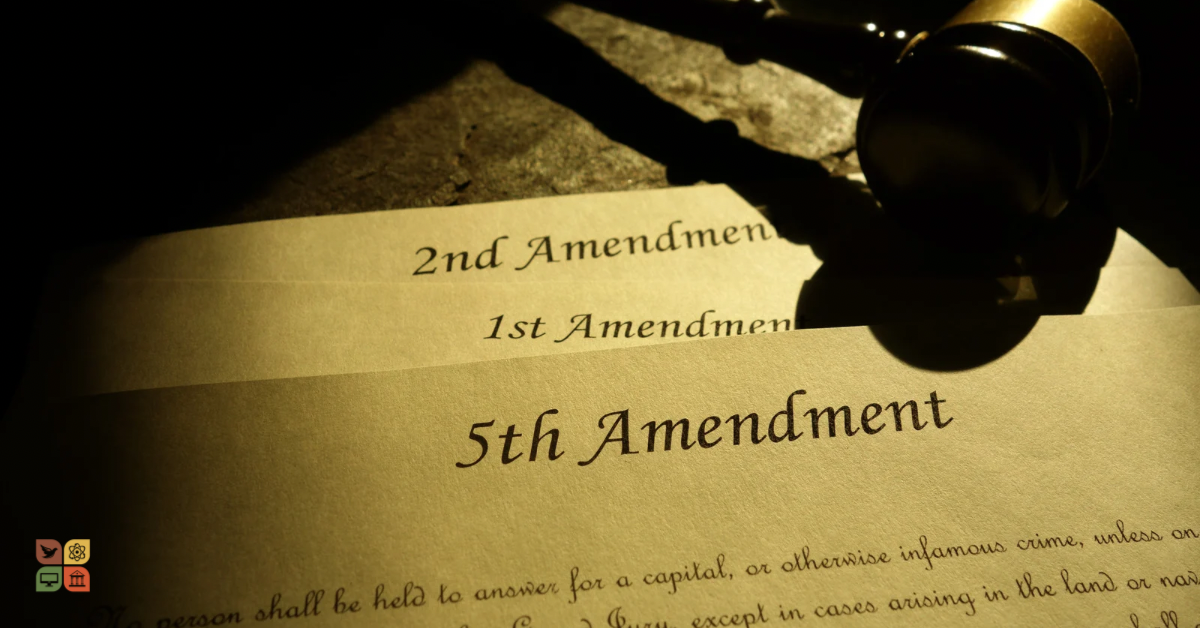
The Fifth Amendment of the United States Constitution is among the most recognizable pillars of individual liberty — often cited, often misunderstood. Its protections form the backbone of American justice, ensuring that no government may deprive a person of life, liberty, or property without fairness, law, and conscience.
It reads, in part:
“No person shall be held to answer for a capital, or otherwise infamous crime, unless on a presentment or indictment of a Grand Jury… nor shall be compelled in any criminal case to be a witness against himself, nor be deprived of life, liberty, or property, without due process of law…”
Each phrase was crafted to prevent the very abuses early Americans had endured under monarchies — arbitrary imprisonment, forced confessions, and the taking of property without recourse. More than two centuries later, those same dangers still test the strength of the amendment and the soul of our democracy.
I. The Right to Silence
“I plead the Fifth.” The phrase has become a cultural shorthand — sometimes mocked, sometimes feared — yet it embodies one of the most profound human rights in existence: the right to one’s own voice, and equally, the right to withhold it.
The framers of the Constitution had studied centuries of legal history, including the brutal English “Star Chamber” where torture was used to extract confessions. They understood that a society cannot call itself free if its people can be forced to testify against themselves.
In the modern age, the form of coercion has changed, but not its presence. It hides in long interrogations, psychological manipulation, and economic pressure to accept plea bargains regardless of innocence. In many cases, silence is no longer a privilege of the informed — it becomes the language of survival for the poor, the frightened, or the wrongly accused.
The Fifth Amendment’s promise is that silence should never have to be purchased or defended. It is an act of dignity — a reminder that conscience is not property of the state.
II. Due Process: The Promise of Fairness
At the heart of the Fifth Amendment lies its most vital command: no person shall be deprived of life, liberty, or property without due process of law.
This simple phrase has carried nations through revolutions and generations through reform. “Due process” means that before the government can take something from you — your freedom, your livelihood, your very existence — you must be treated fairly and given a chance to be heard.
Yet fairness depends on equality, and equality remains unfinished.
Those without resources face impossible odds in courtrooms designed for those who can afford representation. Public defenders, often overwhelmed and underfunded, struggle to give each case the attention it deserves. Cash bail keeps thousands imprisoned not for guilt, but for poverty.
When the system values efficiency over truth, due process becomes performance — a ceremony of justice that hides its inequities beneath procedural formality. The words remain, but their meaning erodes.
The lesson the Fifth offers is not only legal, but moral: justice cannot exist without empathy. A process that favors convenience over compassion fails both the letter and the spirit of the law.
III. The Question of Property
The Fifth Amendment also protects against the taking of private property for public use without just compensation — a safeguard against the tyranny of kings who seized land at will. It enshrined the principle that the government must serve, not exploit, the governed.
But in modern America, the meaning of “just compensation” often comes under question. Through eminent domain, entire neighborhoods have been displaced to make way for highways, factories, or luxury developments. While a few receive payment, many lose not just property, but community, history, and identity.
This clause was meant to restrain power, not justify its expansion. It reminds us that progress cannot be measured only in profit or infrastructure, but in the fairness of how we achieve it. The line between public use and private gain grows thin when citizens no longer have the means to protect what’s theirs.
IV. Between Liberty and Control
The Fifth Amendment’s genius lies in its balance — it grants power to the government to pursue justice, while binding that power with moral limits. Yet time and again, those limits are tested.
During times of fear — war, terrorism, or unrest — the nation has sometimes sacrificed due process for security. From wartime internment camps to indefinite detentions without trial, we see how fragile liberty can be when the public is told it must choose between safety and freedom.
The Fifth Amendment insists that we reject that false choice. It was written precisely for such moments — to remind us that justice without conscience is tyranny wearing the mask of order.
Every generation faces this same test: will we defend these rights when they are most inconvenient? When fear rises and truth falters, the answer to that question defines the era.
V. Lesson in Liberty
The Fifth Amendment teaches restraint — restraint of speech when silence is strength, restraint of government when power tempts abuse, restraint of judgment until fairness has been served.
It calls us to value principle over expedience, process over passion, and truth over noise. It invites us to see the Constitution not as a relic of parchment, but as a living moral compass — one that points toward dignity for all who stand accused, regardless of wealth or status.
To “plead the Fifth” is not an act of defiance, but of trust — trust that a nation built on law and conscience will protect those who cannot protect themselves. The true test of freedom is not how loudly we speak, but how justly we listen.
 The Humane Herald