
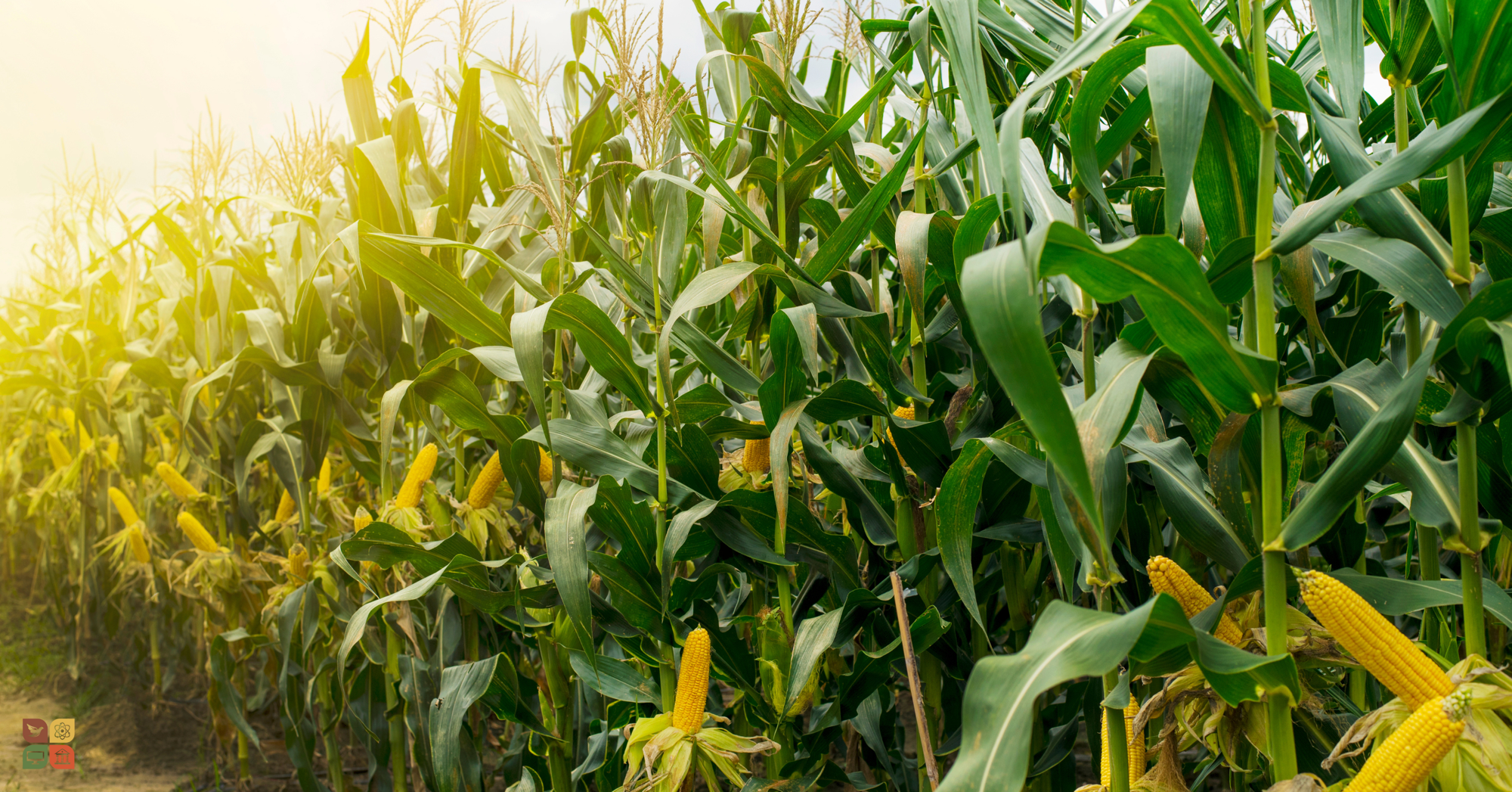
It’s not just a quirky weather term. “Corn sweat” is a documented phenomenon that raises humidity, fuels storms, and exposes the climate consequences of industrial animal agriculture.
In the thick of a Midwestern summer, meteorologists sometimes report dew points so high it feels like the air is sweating. In a way, it is—but not from us.
It’s corn.
More specifically, it’s the water vapor released by millions of corn plants in a process known as evapotranspiration—a fusion of plant transpiration and soil evaporation. Informally dubbed “corn sweat,” this natural process becomes a climate concern when it occurs on the industrial scale we now see across the United States.
According to the National Weather Service, an acre of mature corn can release up to 4,000 gallons of water into the atmosphere per day during peak growth. That’s enough to measurably raise local humidity and dew points, sometimes by as much as 5 to 10 degrees Fahrenheit, creating muggy, heat-intensified conditions that threaten public health and strain cooling infrastructure.
But why is so much corn being grown in the first place?
The answer lies not in direct human need—but in animal agriculture.
A System Built on Feed, Not Food
Despite the abundance of cornfields across the U.S., only a small fraction of that corn goes into human food products. The vast majority—roughly 40 to 45 percent—is grown as animal feed to support the meat and dairy industries. When soy is added to the mix (of which more than 75 percent is also grown for feed), the scale of monoculture farming devoted to animal exploitation becomes staggering.
This is not a neutral fact. These feed crops require intensive irrigation, chemical inputs, and massive land footprints. When summer arrives, and those crops begin their natural evapotranspiration cycle, the resulting “corn sweat” becomes a regional force, altering microclimates, increasing the risk of extreme weather, and worsening climate feedback loops.
The Heat Index Effect—and the Hidden Victims
As corn fields “sweat,” they raise not just humidity but the heat index—the “feels-like” temperature that accounts for moisture in the air. In places like Iowa, Minnesota, and Illinois, dew points regularly exceed 75°F in late July. This excess moisture can:
Create oppressive, dangerous heat conditions Limit overnight cooling, especially in urban and low-income areas Contribute to more intense storms and precipitation events
While local media may treat “corn sweat” as a fun fact or weather trivia, the consequences are anything but lighthearted. The heat impacts disproportionately affect farmworkers, low-income families, and unhoused populations—as well as nonhuman animals, both wild and captive, who have no escape from rising temperatures.
A Feedback Loop of Our Own Making
In a just world, evapotranspiration would be a quiet function of natural ecosystems. But the industrialization of animal agriculture has turned it into something else entirely: a feedback loop.
We raze forests and natural habitats to grow corn and soy. We feed that to animals, whose bodies are used for profit. The crops release moisture into an already warming climate. And the system feeds on itself—ethically bankrupt, ecologically devastating, and increasingly volatile.
All this, for a food system that delivers only a fraction of the calories, protein, and nutrition per acre compared to plant-based alternatives.
The Path Forward
If we want to cool our planet, stabilize our weather, and reduce the toll of climate change, we must confront the root systems that fuel it. And one of those roots—quite literally—is corn.
Ending animal agriculture would shrink demand for industrial feed crops, return land to forests and prairies, and dramatically reduce the kind of evapotranspiration that now steams entire regions under a haze of humidity and suffering.
“Corn sweat” may seem like a quirky phrase. But behind it is a sobering truth: the weather is trying to tell us something. It’s time we listen—and act.
Sources:
•National Weather Service: “Corn Sweat and the Dew Point” https://www.weather.gov/arx/cornsweat
•USDA Feed Grains Database https://www.ers.usda.gov/data-products/feed-grains-database/
•Our World in Data: “Land Use by Diet” https://ourworldindata.org/land-use-diets
•Iowa State University Extension: “Evapotranspiration and Corn Growth” https://crops.extension.iastate.edu/
•American Meteorological Society Journal Articles on Agricultural Evapotranspiration (JAMC, 2016–2022)
 The Humane Herald